research note
COMegon: Putting Beacons to Bed with COM Internals
Introducing COMegon — a sleep primitive that dispatches arbitrary API calls through the COM runtime's RPC machinery.
published
June 21, 2026
read time
16 minutes
author
Noah Baertsch
primary signal
zig
COMegon: Putting Beacons to Bed with COM Internals
About two weeks ago Alex Reid teased a new sleep technique that will be part of an update to his UDRL and Sleepmask Development course hosted by Zero Point Security.
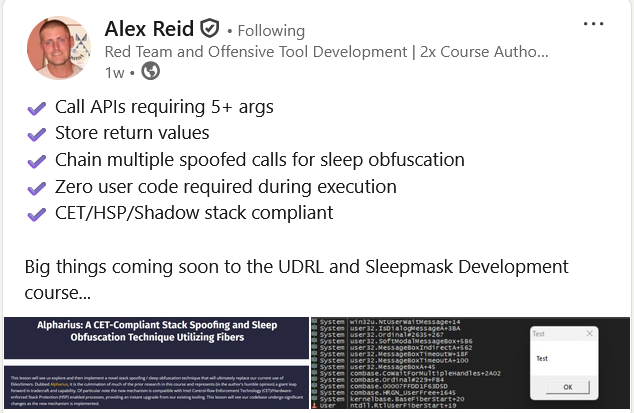
To say the least, this nerd sniped me. I stopped what I was doing and started pulling apart the callstacks, reverse-engineering the COM internals, and building a proof-of-concept implementation for something. I’m fairly confident I did not discover the same tech that Alex is working on, but I built something. The result of the research is COMegon — a sleep technique that routes arbitrary API calls through the COM runtime’s own RPC dispatch machinery.
A quick COM primer
If you’ve never had the misfortune of working below the CoCreateInstance line, the entire COM runtime can sound like an alphabet-soup nightmare. The mental model you need for the rest of this post is small though, so here it is in five paragraphs.
Every COM object is a vtable. A pointer to a COM “object” is really a pointer to a pointer to a function table — that’s it. When you call a method on IUnknown, you’re doing an indirect call through slot 0/1/2 of that table. There’s no type info at runtime, no inheritance check, no validation. The runtime trusts whatever the table says is at slot N.
Threads live in apartments. Every COM-initialized thread is part of an apartment — either a Single-Threaded Apartment (one thread, gets its own hidden message-pumping window) or the Multi-Threaded Apartment (a process-wide free-for-all). A method call between apartments cannot dispatch directly because the threading rules don’t allow it. COM solves this with RPC.
Cross-apartment calls travel as messages. When you call a method on an object that lives in a different apartment, the runtime marshals the parameters into an RPCOLEMESSAGE buffer, posts that message to the destination apartment’s hidden window, and blocks the caller. The destination apartment’s message pump picks it up, walks a chain of metadata to find the real method, unmarshals the parameters, and calls it. The result gets marshalled back into the message and the caller wakes up.
The metadata chain is data. The way COM figures out which function to call on the destination side is by walking a small forest of structs the runtime built at registration time: a stub buffer (the destination-side proxy), a stub header (which interface, how many methods), and a MIDL_SERVER_INFO (a table of function pointers plus a parameter-layout description per method). None of these are signed, validated, or sealed — they’re just heap allocations the runtime hangs onto.
The message pump is ModalLoop. The function in combase.dll that drives the cross-apartment dispatch is named ModalLoop. It calls BlockFn in a tight loop, which alternates between waiting on a real event (the call’s completion notification) and pumping queued messages on the apartment’s hidden window. Pumping a message means DispatchMessageW → ThreadWndProc → the metadata-walk above → your function gets called.
That’s the entire substrate.
The idea
The substrate has a soft underbelly. The runtime trusts whatever pointers are in the metadata structs. If we build the structs ourselves and put our function pointers in the dispatch table, COM’s message pump will happily call them — and from the OS perspective the call originates from combase.dll, not from us.
One wrinkle to get out of the way before the plan: posting a cross-apartment call to your own STA from inside that same STA doesn’t work. COM looks at the caller’s apartment, sees it matches the destination, and short-circuits the dispatch — no marshalling, no message posting, just a direct in-thread call. The whole point of this technique is to take the cross-apartment path, so the queued messages need to be posted from a different apartment. The solution: a short-lived MTA worker thread that joins the process MTA just long enough to PostCall each message into our STA’s hidden window. Its only job is to be a different apartment for a few microseconds, then exit.
The other primitive worth introducing up front is Windows fibers. A fiber is a cooperative-scheduling unit — two (or more) stacks share a single OS thread, and only one is “live” at a time. When you SwitchToFiber, the currently-active fiber’s stack is preserved untouched in memory and the destination fiber’s stack becomes the live one. The OS thread itself doesn’t change. We use fibers to put the caller thread to sleep on its own stack while a second fiber, started fresh at combase!ModalLoop, runs the dispatch — same thread, but the caller’s frames are frozen and the pump fiber’s frames are entirely system code.
With those two pieces in mind, the plan in order:
- Initialize the caller thread as an STA. This gets us a hidden window and a message queue we own.
- Build the metadata structs in memory: a fake stub, a fake stub header pointing at a fake
MIDL_SERVER_INFO, whose dispatch table holds pointers to the Win32 / Nt functions we want to call. - Hand COM a fake
IPSFactoryBufferso that when it asks the runtime “give me a proxy/stub for this interface,” it ends up calling our code and we hand it our forged stub. As part of this exchange COM hands us back a liveIRpcChannelBuffer— that’s the channel the MTA worker will post messages through later. - Each call we want to queue gets translated into an
RPCOLEMESSAGE(allocated via the channel’sGetBuffer) tagged with a method index that maps to a dispatch-table slot. Hand the batch off to a spawned MTA worker, which callsPostCallon the channel for each one. EveryPostCalllands a message in the caller STA’s window queue. The worker signals back when it’s done queueing and exits. ConvertThreadToFiberthe caller into a fiber so its stack is preservable. Initialize aCCliModalLoopvia the runtime’s ownCCliModalLoopCtor(which writes it into TLS whereModalLoopexpects to find it). ThenCreateFiber(ModalLoop, fake_client_call)andSwitchToFiberinto the new fiber.ModalLoopsits in a wait-and-pump loop. Each pumped message drives the metadata walk and lands on one of our queued functions. The last call we queued is always an auto-appendedSwitchToFiber(caller_fiber), which hops us back to the parked caller, where we tear down the pump fiber and reset queue state for the next batch.
While the pump fiber is running, every frame on its stack is in combase.dll, rpcrt4.dll, or ntdll.dll. The caller fiber is parked. The MTA worker is dead. No user-code address is in any live frame anywhere — the implant’s .text can be encrypted while this is happening and nothing will notice.
The dispatch chain
For sleep mode, the cycle looks like this:
This is the full callstack while one of the queued functions is executing:
dispatch-time stack
What ETW / debugger sees during a queued call
MsgWaitForMultipleObjectsEx)dispatch_table[ProcNum]pDispatchTable == -1, routes straight to NdrStubCall2pStub->Invoke via vtableDefaultStubInvokeStubInvokeRPCOLEMESSAGE off the window queueWNDPROCcall into the fiber procEvery frame is in a signed system DLL. No implant address is anywhere on the stack while the call is in flight. The frames above were captured against Windows 11 x64 — the names will be stable across most current builds because they’re internal combase symbols that change rarely.
The architectural consequences of that stack are worth dwelling on:
- Encryption windows are free. Sleep masks like Ekko and Cronos go to elaborate lengths to set up an encrypt-sleep-decrypt chain that doesn’t leave a return address pointing into the implant during the encrypted window. COMegon doesn’t need that engineering — the caller thread is parked on its fiber, the pump fiber is on system frames, and there’s no third user-code thread anywhere. Encryption is just another queued call.
- No
NtContinueor fabricatedCONTEXT. Every transition in the dispatch chain above is a realcall/retpair, which means the hardware shadow stack stays consistent end-to-end. COMegon is CET-safe by construction: there’s no point in the chain where a return address gets fabricated, so there’s nothing for the shadow stack check to disagree with. - No timer queue, no APC chain. Hunt-Sleeping-Beacons and similar tools enumerate the process’s timer queue and APC queue looking for callbacks that point at
VirtualProtectorNtContinue. COMegon’s dispatch is driven byPostMessagetraffic into a window queue — invisible to both checks.
What has to be built
To convince NdrStubCall2 to dispatch to your function, you build a small constellation of fake-but-valid COM data structures at runtime. There are three logical pieces and a bunch of plumbing.
The function pointer table — a MIDL_SERVER_INFO. This is the structure that ties everything together. It points at your dispatch table (the array of function pointers, one per slot you want to call), at your NDR format strings (one per slot), and at the standard NDR 2.0 transfer-syntax GUID. NdrStubCall2 consults this struct on every dispatch to figure out where to send the call.
The parameter-layout descriptions — NDR format strings. For each function you want to dispatch to, you build a small Oi2 procedure format string at queue time that describes the parameter layout: count, types, stack offsets, and total frame size. NdrStubCall2 parses this to know how to unmarshal the parameters out of the inbound RPCOLEMESSAGE and onto the call frame. The current implementation handles 8-byte parameters with an HRESULT-shaped return, which is enough for almost every Win32/Nt API since they all pass 64-bit values on x64.
The stub — a CStdStubBuffer plus a CInterfaceStubHeader. This is what CStdStubBuffer_Invoke actually receives as its this pointer. The runtime expects to walk from this to the stub header, then from the header to the MIDL_SERVER_INFO above. The load-bearing detail here is a sentinel: setting the header’s pDispatchTable field to -1 tells CStdStubBuffer_Invoke to route the call straight to NdrStubCall2 using the MIDL_SERVER_INFO’s dispatch table. Any other value steers the runtime into a different server-side dispatch path entirely. Picking the -1 sentinel is what makes everything else line up.
The plumbing around those three structs gets the runtime to find our fake stub when the message arrives:
- The caller thread initializes apartment-threaded COM, then registers a fake
IPSFactoryBufferunder a custom CLSID viaCoRegisterClassObject. - The caller calls
CoMarshalInterThreadInterfaceInStreamto marshal a fakeIFiberDispatchinterface pointer. - A short-lived MTA worker calls
CoGetInterfaceAndReleaseStreamon the marshal stream. COM hits the marshal protocol, calls back into ourIPSFactoryBuffer::CreateProxy, and hands us a liveIRpcChannelBufferto capture for later. CoIncrementMTAUsagepins the process MTA without keeping a worker thread resident, and the helper exits.
Once that’s done, the channel is wired and reusable. Each subsequent pump() just allocates an RPCOLEMESSAGE via the channel’s GetBuffer, fills in the method index, and PostCalls it into the caller STA’s window queue.
The pump fiber itself is the last piece. Rather than entering ModalLoop from the caller thread’s existing stack (which would put framework frames above the dispatch chain), the caller hands ModalLoop to Windows’ fiber machinery and lets the OS’s fiber startup establish a clean stack. The setup is small:
- Initialize a
CCliModalLoopstructure via the runtime’s ownCCliModalLoopCtor. Lettingcombaseconstruct it means COMegon inherits whatever exact field values the OS expects — including thefCoWaitCalled=1flag that tellsBlockFnto actively dispatch already-posted STA messages instead of just blocking on a wait. - Build a small fake “client call” object — the parameter
ModalLoopexpects — with an inner object whose vtable slots all point atcombase!NoOpReturn0and a fresh event handle forBlockFn’s wait. CreateFiber(stack_size, ModalLoop, fake_client_call)—ModalLoopis the fiber entry point directly, no wrapper.SwitchToFiber(pump_fiber).
The pump fiber’s entire stack is system frames: BaseFiberStart → ModalLoop → BlockFn → message dispatch → your APIs. Done.
For the byte-level details of the structs (offsets, exact field values, the NDR format string layout, the fake client_call struct, the stub vtable), see the COMegon source — the README has full layouts and the implementation has the rest.
Sleep Mode: Public API
// Initialize — CoInitializeEx(STA), CoIncrementMTAUsage, register fake PS factory,
// capture proxy channel, ConvertThreadToFiber. All in one call.
var ctx = try comegon.init(.{ .max_slots = 256 });
defer ctx.deinit();

// Queue N calls, fire them all, block until done.
// Sleep uses MsgWaitForMultipleObjectsEx so the underlying wait is COM-aware and
// doesn't trip the same detection patterns as raw NtDelayExecution.
const fn_VirtualProtect    = resolve("kernel32.dll", "VirtualProtect");
const fn_SystemFunction032 = resolve("advapi32.dll", "SystemFunction032");
const fn_MsgWait           = resolve("user32.dll",   "MsgWaitForMultipleObjectsEx");

ctx.queue(fn_VirtualProtect,    &.{ text_base, text_size, PAGE_RW, &old_prot });
ctx.queue(fn_SystemFunction032, &.{ &img_range, &key_range });
ctx.queue(fn_MsgWait,           &.{ 0, 0, sleep_ms, 0, 0 });
ctx.queue(fn_SystemFunction032, &.{ &img_range, &key_range });
ctx.queue(fn_VirtualProtect,    &.{ text_base, text_size, PAGE_RX, &old_prot });
ctx.pump();  // blocks until all 5 calls + auto-appended SwitchToFiber(caller_fiber)
That’s the whole sleep encryption loop. The caller’s .text can be flipped to RW and XOR’d while no thread in the process has a return address pointing into it. Wake it back up by flipping back to RX, then the auto-appended SwitchToFiber(caller_fiber) returns control.
Proxy Mode: Single Synchronous Call
For one-off calls that need a return value, there’s invoke():
const status = ctx.invoke(fn_NtAllocateVirtualMemory, &.{
    process, &base, 0, &size, MEM_COMMIT, PAGE_RW,
});
This dispatches through the same COM channel but via SendReceive (synchronous) instead of PostCall (async), and captures the HRESULT return value. Same callstack profile as sleep mode — no implant frames during the call.
A Note on CLSIDs
COMegon registers its proxy/stub factory under a custom CLSID. The default in the source ({A1FA0000-A1FA-A1FA-A1FA-A1FA00A1FA00}) is intentionally obvious for development — for operational use you want a CLSID that:
- Does not exist in
HKCR\CLSIDon the target OS. Real registrations cause COM to load the actual DLL instead of our in-process factory, breaking initialization. - Is not in the Microsoft OLE range
{000003xx-0000-0000-C000-000000000046}. combase has special internal handling for those. - Blends into a legitimate Windows subsystem GUID range so a casual inspection doesn’t flag it.
The comegon.zig source has a list of candidate ranges that fit those constraints. Picking one is operator hygiene, not a framework concern.
Detection Testing
COMegon’s dispatch primitive was tested in isolation against four open-source beacon hunters and memory scanners during active sleep/wake cycling — 5 × 20s COM sleep + 10s wake, with elevated scans using SeDebugPrivilege:
| Tool | Author | Checks | Result |
|---|---|---|---|
| Hunt-Sleeping-Beacons | thefLink | Unbacked stack frames, non-exec pages in stack, stomped modules (CoW), APC dispatch on stack, timer callback enumeration, return address spoofing, abnormal intermodular calls | ✅ Clean |
| pe-sieve | hasherezade | Implanted PEs, shellcode (pattern + stats), inline hooks, IAT hooks, patched headers, thread anomalies | ✅ Clean |
| Moneta | forrest-orr | Private RWX memory, Copy-on-Write anomalies, modified code sections, unbacked executable regions | ✅ Clean |
| Patriot | joe-desimone | Suspicious CONTEXT structures (Ekko/Foliage), unbacked executable regions, modified code (stomping), PE integrity | ✅ Clean |
To be honest about what these results actually show: this is the dispatch primitive in isolation. COMegon gives you a clean callstack during dispatch, but where the calling code lives — injected memory, stomped module, on-disk PE — independently affects what these tools (and EDRs) see during the rest of the process lifetime. COMegon clears the sleep-time stack-walk gauntlet; it doesn’t make a bad implant good.
CET & HSP Compatibility
This is the part I’m most happy about. COMegon is CET shadow stack compatible by design — the whole technique runs through legitimate call/ret pairs:
ModalLoopis reached viaCreateFiber→BaseFiberStart→ModalLoop(normal indirect call to a fiber proc, CET-compliant)- Every dispatch inside the modal loop is a
call → ret, both pushing and popping the shadow stack symmetrically - No
NtContinue, no fabricated CONTEXT structures, no ROP returns, no stack pivots, nojmpover a faked return address
Verified with /cetcompat opted in (sets IMAGE_DLL_CHARACTERISTICS_EX_CET_COMPAT in the PE debug directory) on Windows 11 x64 with HVCI enabled: 5/5 runs stable with hardware shadow stack enforcement, zero #CP faults. Both sleep mode and proxy mode pass.
For CET-enforced builds, Zig 0.14.x has no native --cetcompat flag, so the build is a two-step: zig build-obj to produce a COFF, then zig lld-link with /cetcompat to set the PE flag. Full incantation is in the README.
Honest Limitations
A few things worth being upfront about:
The caller thread becomes the STA. init() calls CoInitializeEx(NULL, COINIT_APARTMENTTHREADED) on the calling thread, then ConvertThreadToFiber(NULL) on the same thread. You don’t have to set the apartment up yourself, but if the host process already initialized that thread as MTA (or as STA via a different fiber/apartment state), init() will fail with RPC_E_CHANGED_MODE or similar. If your host’s threading model conflicts, run COMegon on a dedicated thread.
CLSID hygiene matters. As covered above, picking a CLSID that’s already registered breaks initialization. Operational use requires care.
combase internal function resolution. COMegon uses signature scans against combase.dll to resolve a handful of internal functions (ModalLoop, CCliModalLoopCtor, PostCall, NoOpReturn0). Version-gated fallbacks cover known-good builds, but a major Windows update could shift signatures and require an update to the patterns.
Short-lived MTA workers per cycle. The initial channel marshal requires an MTA helper, and every subsequent pump() / invoke() also spawns a short-lived MTA worker — one to do PostCall for the batch, one to do SendReceive for proxy calls. Each worker exits before its corresponding dispatch begins, so no helper thread holds a user-code frame on its stack during the actual sleep window. But these transient MTA threads do exist briefly and call into combase.dll. They’re the noisiest moments in the technique’s lifecycle.
What’s Next
The current implementation locks in a fixed max_slots at init time. There’s no fundamental reason the MIDL tables couldn’t grow dynamically, but the bookkeeping gets messier and the current ceiling (249 calls per pump) hasn’t been a practical limit.
Proxy mode (invoke()) currently captures only HRESULT-style returns. Wider return-type coverage via richer NDR format strings is straightforward to add when needed.
There’s also a research thread around whether the same pipeline can be driven from inside an existing apartment that the host process already initialized — re-entering the modal loop on a thread that’s already pumping for legitimate reasons. That would eliminate the apartment-initialization step entirely. Invasive, but interesting.
Resources
- COMegon — The implementation
- Frame Cascade — Related:
NtContinue-based dispatch - pool-proxy-ng — Related: thread-pool dispatch
- COM Threading Models — STA/MTA/RPC fundamentals
- COM Marshaling Internals — Background on
CoMarshalInterThreadInterfaceInStream - Hunt-Sleeping-Beacons, pe-sieve, Moneta, Patriot — The detection tools tested against